
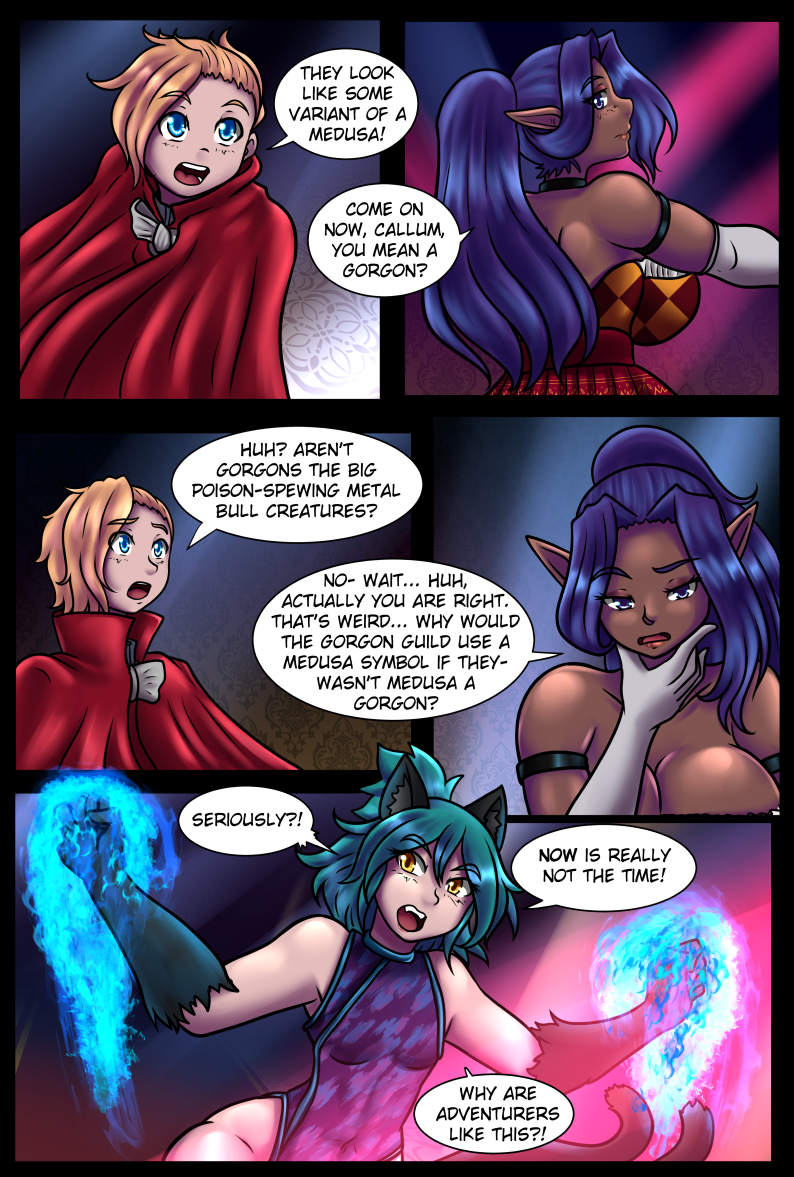
For anyone confused by this, in D&D a Gorgon is a metal like bull (originally it was a magical beast with plates like metal and now its seen more as a living construct). Rune Aria, the game they are in, uses a lot of things from D&D and other fantasy games to make up the world and creatures. The choice to use the Bull over the traditional Medusa has to do with a lot of game’s using Medusa type Gorgons – but calling them Medusa! Which, D&D also did, but a lot of games have done it too. Many games mix up Gorgon/Medusa so much that honestly- it doesn’t really matter anymore, it’s just something for nerds to argue over… Which is why the Gorgon group in Rune Aria use a Gorgon (Snake Woman version) as their symbol, it’s a nerd protest name against the use of Medusa to mean Gorgon and Gorgon being a creature misrepresented as a Gorgon… Wait, i actually didn’t even explain that bit… So, no no, I’m not going to do all that. There was a bull like creature that spewed fire from it’s nose and had metal hooves or something and it had a complicated name and at some point something happened and someone called it a gorgon and everyone was already calling the other gorgons medusa anyways and HERE WE ARE!

Makes me think of the whole Dragon/Wyvern/Wyrm situation
not really, since the distinctions between those are all artificial. they’re all just different names and depictions of the concept of dragons, and the divisions that RPG’s and poorly written kids books divide them into don’t even match up in terms of cultural source with the depictions they’re assigning the different terms to. (it drives me crazy seeing people arguing that a dragon in a movie “isn’t a real dragon’ because some poorly paid ghostwriter got told to write a book for kids about dragons, and way too many people took the complete nonsense in it as some kind of gospel for the last half century.
The difference between Wyvern and Dragons started on BRITISH crest symbolism, in the rest of the world, there was not really much of a difference ever made.
I thik the General agreement is
if it has two arms, two legs, as well as two wings then its a dragon.
if it has two Legs and No arms, or the wings double as arms then its a wyvern
Wyrms and easterns make it tricky though.
Of course none of this matters if the world setting says its a ‘dragon’ then its that worlds ‘dragon’
Kinda like how Kobalds are both dog people and lizard/dragon people and Gnols are both hyena people and small gnome-sized trolls.
Originally they are small dog-people, but with scales instead of fur, the japanese turned them into dog-people while western entertainment went on the scaled version instead, keeping the small form and the doggish snout.
Some versions are even said to be decendants of Dragons.
too much knowledge not enough power?
the fire breathing bronze bulls were the Khalkotauroi, also called the Colchis Bulls. in the Argonautica, jason has to use the two bulls to pull a massive plow and seed the plowed field with dragons teeth (which grow armed soldiers), as one of the trials to obtain the golden fleece.
Of course, in the original mythology that D&D drew from, ‘Medusa’ and ‘Gorgon’ were names… ‘Medusa’ being the name of an individual, and ‘the Gorgons’ being her and her two sisters, Stheno and Euryale, the latter two of whom were immortal. All three of them were monsters who could turn people to stone, though the other two sisters are only mentioned a couple of times in the surviving legends and there aren’t many consistent descriptions of them, though they appear to have had wings in some depictions.
So, Medusa was a Gorgon, but not the only one.
D&D, of course, drew from a lot of different versions of pop mythology and completely messed up a lot of the terminology in the process.
Whew, that is a spicy one, yeah.
Screwing up “gorgon” started all the way back with Ovid’s fanfiction of Greek mythology.
Tbf every telling of Hellenic myth was fanfiction, even the very first.
*Especially* the very first.
The gorgon thing has been traced to a medieval bestiary entitled ‘The Historie of Foure-Footed Beastes’ (yes, with that spelling) published in 1607 by Edward Topsell. That gorgon is also called the “Libyan beast” and is basically a catoblepas. Which D&D also has, as a different creature.
I guess it was called a gorgon because of its alleged paralyzing stare, which was in common with the Medusa of mythology.
About dragons/wyverns: this is actually from British heraldry. Specifically British heraldry. The heraldry of other countries (like France, Germany, Italy…) doesn’t make a distinction between dragons and wyverns. (Note that heraldic wyverns usually have the legs just below the wings, instead of following a tetrapod body plan like that of a bird with the legs behind the wings.)
Earliest descriptions of dragons in Western mythology are more like hydras. Think about Ladon in Greek mythology, a dragon with a hundred heads who guarded the Garden of the Hesperides. In fact, the hydra was a dragon that just happened to live in water.
Kobolds: the original creatures are basically same as goblin, nisse, brownie, domovoy, etc. Just small people, household spirits. D&D described them first as “dog-like humanoid with a scaly skin and small horns”, and some translations of it (notably in Japan) went very hard on the doglike part, forgetting the scaly skin part and making them dog people. Later edition went hard on the scaly skin and small horns part, making them tiny dragon people. But in both cases, this was pure D&D invention; folklore kobolds look just like tiny human, sometimes with a big bushy beard, and sometimes they can shapechange into cats, depending on local traditions. Fun fact: the metal cobalt is named after them, it’s “goblin silver” basically.
Google the Colchis bulls
Callum and Kaylin nerding out while Nyna has to lead the fight XD
“Why are Adventurers like this?”
My theory is that they’re displaying autistic hyperfixation… but then, what do I know?
Ah gaming nerdery! Wait wow, that’s an actual legitimate word? Didn’t give me the angry red squiggly line underneath it when I typed that. Anyhoo – ah see! Did it there!
Well if Callum and Kaylin are taking a moment to casually discuss this topic it’s a good sign they aren’t too concerned so far about what they are up against.
Just means it’s used often enough that it’s in spell check’s lexicon